



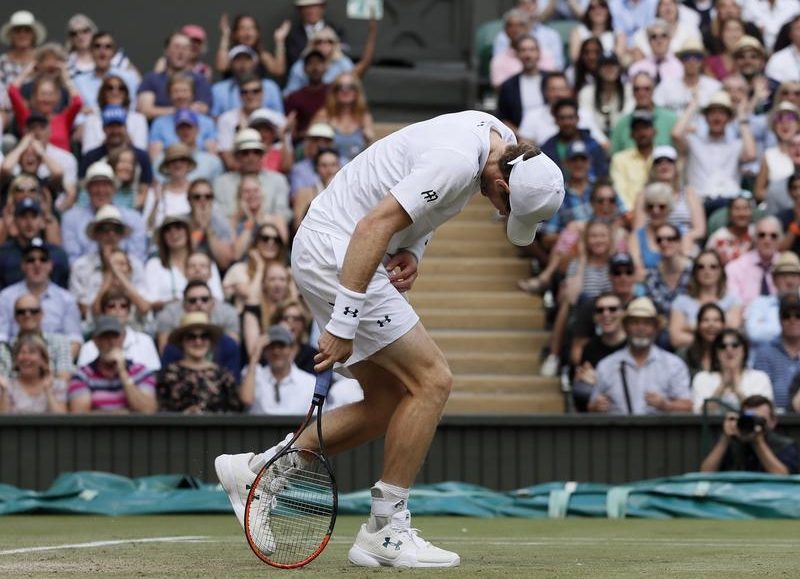
Novak Djokovic and Stan Wawrinka have reputations for being supreme athletes but a gruelling tennis season has left them among a number of big-name players missing from the US Open with injuries.
Despite sports medicine advances and a greater understanding by the players on how their bodies work, there is little down time for anyone who wants to be a regular competitor during the ATP and WTA seasons, which last approximately 11 and 10 months, respectively.
“Most of the injuries in tennis are what are classified as overuse,” Todd Ellenbecker, the ATP’s vice president of medical services said.
“Not one particular force or trauma but a continued, repeated, overload of smaller forces that lead to a breakdown in the player’s body.”
Five top 11 men’s players are among those who have said they will miss the year’s final grand slam, starting Monday in New York: former world No.1 and two-time champion Djokovic (elbow), 2012 champion Andy Murray (hip), 2016 champion Wawrinka (knee), Canada’s Milos Raonic (wrist) and Japan’s Kei Nishikori (wrist).
The women’s draw has not been robbed of the same level of star power with the most high-profile withdrawal due to injury being 2011 US Open champion Samantha Stosur (hand). Six-time champion Serena Williams is absent due to pregnancy.
With a non-stop stream of tournaments on hard courts, grass and clay, coupled with racquet technology that allows players to hit the ball harder than ever before, the physical toll on bodies mounts up.
“Tennis is indeed unique in that it is one of the only high level sports played on multiple surfaces at the elite level,” said Ellenbecker. “We know that different ball speeds, and trajectories-court surface interfaces do affect the player’s body. However, definitive injury risk research is scant.”
Ellenbecker said after matches, a player’s focus shifts immediately from performance to recovery sessions.
Bill Norris, the ATP’s former director of medical services who spent 35 years patching up the broken and sore bodies Ken Rosewall to Roger Federer, said players have little choice but to pace themselves by taking regular breaks if they want to stay competitive late in their careers.
“Federer has changed a lot of coaches, but he’s kept a great team around him,” said Norris.
“By (age) 30-35 you know what your body is capable of, what the competition is capable of. If you schedule yourself right and pace yourself you will have some reserve.”
The run enjoyed by Federer and 37-year-old American Venus Williams, a finalist at both the Australian Open and Wimbledon this year, has prompted many to ask whether a 40-year could soon walk off with one of the four grand slam titles.
“From a truly anatomical standpoint, the work the players are doing now to maintain elite levels of human performance well into their 30s it is indeed possible and perceivable that we might see champions at this level among players in their 40s,” said Ellenbecker.